Preamble
- Jim Silberman, the little known board member from Laurel, Maryland, finished in second place in the 2025 Election Exit Poll, trailing the winner, Don Deraska, by only one vote; and
- In a working meeting to amend the restrictive covenants held on July 12, 2010 then president David Wiecking advocates to give the elected board wide-ranging powers at the expense of the membership.
My name is Gregory Pichler with the MXB Wire, reporting from the Glenwood Road Studio, and you are watching my special community update for Tuesday, October 7, 2025.
Jim Silberman, the little known board member from Laurel, Maryland, finished in second place in the 2025 Election Exit Poll, trailing the winner, Don Deraska, by only one vote
As you may be aware the MXB Wire has been conducting an exit poll, or survey, of the 2025 Board Elections at the Fall meeting held on Saturday, August 30, 2025. The purpose of the exit poll is to determine the impact of so-called board-designated, proxy ballots have in an election cycle.
The MXB Wire and its business partner, Open Systems Group, LLC, ran the exit poll (or survey) for approximately five weeks and we collected a number of survey responses.
The following illustrates a portion of the results.
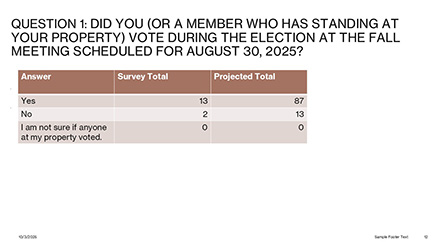
2025 Election Exit Poll, Question 01, Results
Out of the fifteen respondents to question number 1, Did you vote during the election at the Fall meeting scheduled for August 30, 2025?, thirteen respondents answered, Yes; two answered No.
Given the data, we project that only 87 people, who represent 87 residential properties, voted in the 2025 election. We arrived at that projection due to a number of assumptions, including the voter apathy rate.
The board expended little effort in recruiting candidates for the 2025 Board Elections. The board, likewise, expended little effort to recruiting candidates for the 2024 Board Elections.
The 2025 Board Election was anything but a competitive election. Five candidates were vying for four two-terms. Further, there was also the one year balance on a two-year term due to the untimely death of Kerry Hall. In effect all of the candidates were guaranteed a seat on the board. So, there was very little incentive to vote at all. In addition, there is a large segment of the community, who do not vote in any election. We also assume that people who choose never to vote, likewise never respond to a survey. When you add the portion of the voting populate who never vote with the people, who chose not to vote in the 2025 we arrive at a voting population of 36.25%.
This does not take into consideration the number of property owners, who own more than one property. There are a number of them. However, we discounted separating this population altogether.
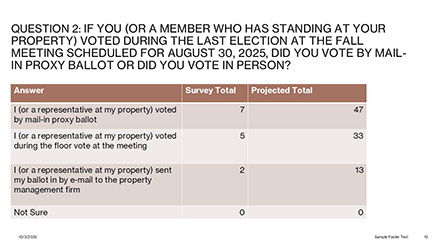
2025 Election Exit Poll, Question 02, Results
Out of the fourteen respondents to question number 2, If you voted during the last election at the Fall Meeting scheduled for August 30, 2025, did you vote by mail-in proxy ballot or did you vote in person?, seven respondents answered, I voted by mail-in proxy ballot; five answered I voted during the floor vote at the meeting; and two answered I sent my ballot in by e-mail to the property management firm.
Given the data, we project that forty-seven people, voted by mail-in proxy ballot, whereas thirty-three people voted during the floor vote, whereas thirteen people sent their ballot in by email to the property management firm.
I counted somewhere between twenty and twenty-six residential properties were represented at the Fall meeting. When you add the eight board members present at the meeting, you arrive at the figure we project that attended the floor vote, that being thirty-three. This is a good check that our assumptions in how we arrive at voter apathy are relatively accurate.
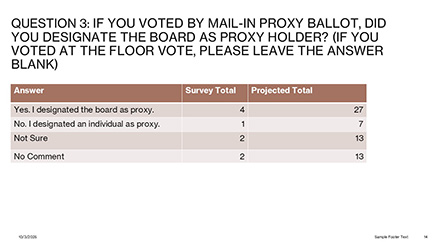
2025 Election Exit Poll, Question 03, Results
Out of the nine respondents to question number 3, If you voted by mail-in proxy ballot, did you designate the board as proxy holder?, four respondents answered, Yes. I designated the board as proxy.; one answered No. I designated an individual as proxy.; two answered Not Sure; and two answered No Comment.
Given the data, we project that twenty-seven people, designated the board as proxy, whereas seven people designated an individual other than the board as proxy. Regarding the people who either answered Not Sure or No Comment that would effectively tilt the projections.
As a total of only seven respondents answered that they had voted by mail-in proxy ballot on question 2, it is possible that the respondents, who answered No Comment on question 3, are people, who either voted at the floor vote or people, who forwarded their ballot by e-mail to the property management firm.
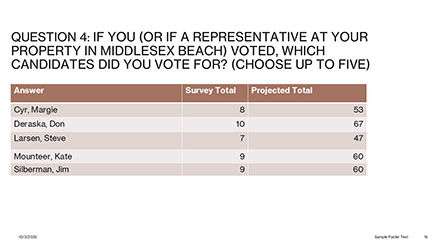
2025 Election Exit Poll, Question 04, Results
Now the question we have been waiting on, who won the election in the context of the voting membership, discounting the board-designated proxy ballots.
Out of the thirteen respondents to question number 4, If you (or if a representative at your property in Middlesex Beach) voted, which candidates did you vote for? (choose up to five), who reported they voted in the 2025 Election, eight respondents said they voted for Margie Cyr; ten respondents said they voted for Don Deraska; seven respondents said they voted for Steve Larsen; nine respondents said they voted for Kate Mounteer; and nine respondents said they voted for Jim Silberman.
Given the data, we project that fifty-three votes went to Margie Cyr, sixty-seven votes went to Don Deraska, forty-seven votes went to Steve Larsen, sixty votes went to Kate Mounteer, and sixty votes went to Jim Silberman.
Given the data, Don Deraska won the election albeit by one respondent's vote. Don Deraska secured a two-year term on the board. Jim Silberman did very well, winning a two-year term on the board. Kate Mounteer also did well. Kate Mounteer also won a two-year term on the board. People like Kate.
Given the data, the people, who form the leadership on the board, did not perform well. Margie Cyr secured the fourth and final two-year term on the board, whereas Steve Larsen failed to secure a two-year term on the board. Steve Larsen should have been handed the one-year balance of the two-year term vacated by Kerry Hall. Instead on August 30, 2025 the board elected Larsen as president of the board.
The board would have us believe that in the 2020 Election, Steve Larson garnered the highest number of votes of all the nine candidates, who sought a board position that year. Larsen reportedly received 93 votes. The only other candidate close to that figure was Ellen Throop. Throop, who came in second, received 81 votes in the 2020 election, twelve votes behind Larsen. However, the figures from the 2025 Exit Poll do not indicate overwhelming support for Larsen from the membership at large.
Larsen is the same man he was in 2020. I see no reason for Larsen's reputation in the community to take a major fall. And yet, Larsen finished last in the recent Exit Poll.
The 2025 exit poll result indicates that if the projections are relatively accurate, and not dramatically skewed due to some obscure reason, that the people, who oversee the function of the board, the executive committee, the people, who have access to the board-designated proxy ballots, are overvoting these ballots to keep themselves in office and they are likely doing so election cycle after election cycle.
However, the exact method elements on the board are using are not being shared amongst the entire board. In fact I have it on solid information that the majority of the board members have no idea, who is responsible for the board-designated proxy ballots and how they are being exercised.
As an aside in the 2020 Election Throop was followed by Nancy Glasgow, who received 80 votes, followed by Carol Paul, who received 76 votes.
The board reported that Steve Larsen, Ellen Throop, Nancy Glasgow, and Carol Paul, all earned two-year terms on the board in 2020.

2025 Election Exit Poll, Question 16, Results
I know what you are about to ask. You are about to ask, what about the board-designated, proxy ballots? Shouldn't those be counted.
In his e-mail message, dated August 29, 2025, David Wiecking said (paraphrasing) it was his duty to overvote the ballots, favoring the people he trusts and wants to work with on the board and that this was his special obligation to the membership. [1] Well. Let's look into that.
Out of the fourteen respondents to question number 16, Were you aware that if you leave your 2025 ballot blank, having no selections, that the proxy holder is then at liberty to mark any selections on your ballot?, seven respondents (46.6%) answered, Yes. I am aware that if I leave all the selections blank that the proxy holder can overvote the ballot.; five (33.3%) answered No. I was not aware that if leave all the selections blank that the proxy holder has the right to overvote the ballot.; and two (13.3%) answered Not Sure.
Given the data, we project that 46.6% of the communty members are aware that if they leave all the selections blank that the proxy holder can overvote the ballot, whereas 33.3% of the community members are not aware that if they leave all the selections blank that the proxy holder can overvote the ballot. It is unclear what the remaining 13.3% of all community members believe as to how proxy ballots are handled.
So, where in his e-mail message, dated August 29, 2025, does David Wiecking get the justification for believing it is his duty to overvote the proxy ballots, particularly where nothing is mentioned on the ballot as to what constitutes a board-designated ballot and the rules that permit the board (whoever that happens to be) to overvote a ballot? It was just recently, just this election cycle that the board issued visible instructions, indicating that if you do not enter any selections on a ballot, that the proxy holder can overvote a ballot.

2025 Election Exit Poll, Question 17, Results
Out of the fiteen respondents to question number 17, Do you ever recall seeing language on the ballot indicate that if you do not fill in any selections on the ballot that your designated proxy can over-vote your ballot?, six respondents (40%) answered, No. I cannot recall ever seeing this language on the ballots of previous election cycles.; five (33.3%) answered I am not clear whether this language appeared on previous ballots. However, I knew that if I left all my selections blank that the proxy holder can overvote my ballot.; none (0.0%) answered Yes. The ballots of previous election cycles clearly explained this. I knew that if I left all my selections blank that the proxy holder can overvote my ballot.; none (0.0%) answered Sometimes. The ballots of some previous election cycles clearly explained this, but not all the time or the language on the ballot was confusing.; and two (26.6%) answered Not Sure.
Given the data, we project that 40% of the community members cannot recall ever seeing this language on the ballots of previous election cycles, whereas 33.3% of the community members are not clear whether this language appeared on previous ballots. However, these community member knew that if they left all my selections blank that the proxy holder can overvote their respective ballot. It is unclear what the remaining 26.6% of all community members believe as to this language stipulating how proxy ballots are handled was ever addressed on the ballots of past election cycles.
EDITOR'S NOTE: We changed question 17 in mid-flight to add the answer, Yes. The ballots of previous election cycles clearly explained this. I knew that if I left all my selections blank that the proxy holder can overvote my ballot.. Three respondents answered No. I cannot recall ever seeing this language on ballots of previous election cycles., and not six as reported. Three respondents answered Yes. The ballots of previous election cycles clearly explained this. I knew that if I left all my selections blank that the proxy holder can overvote my ballot., and not zero.
In a working meeting to amend the restrictive covenants held on July 12, 2010 then president David Wiecking advocates to give the elected board wide-ranging powers at the expense of the membership.
Since uncovering evidence into the deliberate manipulation of community elections via so-called "board designated" proxy ballots, without having explicit authority by the membership to do so, as well as the auspicious change to the by-laws in January of this year, I have been spending time investigating the context behind the 2015 change to the restricted covenants as well as the context behind the 2009 change to the by-laws as well as the Restated & Amended Certificate of Incorporation of Middlesex Beach Association, last adopted on March 13, 2010. All these changes to the corporate legal documents were made under David Wiecking's tenure as community president.
Unfortunately, as I had attended very few of the meetings precipitating these actions, my progress has been somewhat hampered. I have no archive materials pertaining to the revisions to the bylaws and do not recall attending any meetings in which the changes to the bylaws were discussed. Similarly, I have no archive materials pertaining to the restated & amended Certificate of Incorporation of the Association.
I did not discover any evidence that a change to the authority as to who is responsible for revisions to the bylaws occurred under David Wiecking's watch. In 2009 just as in 2025 the board voted to revise the bylaws, not the membership. However, I did discover a number of documents in the archive pertaining to community discussions in 2010, leading to the change to the restrictive covenants in 2015. I found one of the discussion points very telling.

Restrictive Covenants Working Meeting, Discussion Notes, dated July 9, 2010
Apparently, in a working meeting sometime immediately after July 9, 2010, the cut-off date of discussion points, David Wiecking answered a question presumeably by David Burgess [2]. David Burgess writes:
The "Association" is defined in the Covenants as the Corporation of Middlesex Beach property
owners who are also members of the Association. The Corporation elects a Board of Directors. The
Association and its Board of Directors are not the same. The document must be clear who is responsible for
performing certain acts when it says "The Association." Please clarify in every case (Board, Board
President, Committee, Delegated Authority, Security, or Board AND 60% of Members). Be specific who is
responsible.
In David Wiecking's response he writes:
we intentionally made all references to the same entity. The community (Association) has
certain specific powers, including the power to elect the Board, to whom most of the power is delegated. The
Board is ultimately responsible. Perhaps clarifying we mean "The Association, through its elected Board")
In fact as I read the most recent incarnation of the Restrictive Covenants I can find no authority the membership possesses outside the board other than to elect a board of directors and even that has been effectively neutralized due to the board's disingenuous handling of proxy ballots. I find this aggressive, penchant for authority on the part of Wiecking consistent with his overarching personality. Wiecking has many admirable qualities. Wiecking is giving to the extreme of his time and resources. There is almost nothing the man will not do when asked a favor of. However, I find that sharing a decision is not in Wiecking's reportoire of virtuous personality traits.
I first met David Wiecking in the Spring of 2006 when I discovered that the water pump at the property at 20 Dune Road, Bethany Beach, Delaware, had been damaged from the Winter season. The water pump was not properly Winterized in the Fall of 2005. Wiecking hooked up a hose from his property at 15 Dune Road to my property at 20 Dune Road and shared his water supply from the Artesian Water Company with me.
Later that year, I scrapped the well water system the property had been on since 1961 and signed on with the Artesian Water Company, largely due to David Wiecking's endorsement of the service.
Since I first met David Wiecking in 2006 I find David Wiecking a difficult person to work with where a decision has to be mutually agreed upon.
In 2015 or thereabouts, Sharon Adams, who was the past president and the chair of the Nominating Committee at the time invited me to run for a position on the board. I declined the invitation. I sent Sharon Adams an e-mail message, explaining the reasons I elected not to seek a position on the board. [4] In my e-mail message, I write:
Sharon,
Earlier this year you asked if I would be inclined to run for a position on the board. After some
consideration I have decided I will not seek a position on the board.
In fact on August 15, I wrote Judy Myers to inform her my decision, thinking you were Judy. I apologize
for the confusion with names. Somedays, I feel fortunate to wake up knowing my full name.
I wrote a somewhat detailed e-mail message, expressing my reasons for declining the opportunity to
serve on the board, but I see that my issues with a number of current board members and their past
behavior are once again falling on deaf ears. I will not bore you with the details.
Cheers,
Earlier on August 15, 2015 I had mistakenly sent Judy Myers an e-mail message, thinking she was Sharon Adams, expressing my reasons for declining Sharon Adam's offer to run for a position on the board. In brief, I informed Judy not Sharon, that I did not need the stress of working and arguing points with Wiecking.
The Story of Jeff Stoiber
Jeff Stoiber is a one-term, former board member who discovered what happens to board members, who defy Wiecking's determination and strength of will. David Wiecking recruited Jeff Stoiber to seek a position on the board in 2011. Stoiber won a two-year term on the board at the Fall meeting in 2011. Although Wiecking confered the position of Director onto Stoiber, Wiecking reportedly had greater designs for Stoiber. Wiecking directed Stoiber to levy a number of punitive fines to members for building rule violations. The punitive fines were often in the quantum of thousands of dollars. Stoiber refused to levy what were in his mind excessive punitive fines. In 2013 Wiecking reportedly recruited another first-time candidate to replace Stoiber, namely Judy Myers. Ultimately, Wiecking reportedly "proxied out" Stoiber over the course of the Fall, 2013 election cycle, seeing to Myers's successful campaign in replacing Stoiber.
It is not clear where the proceeds of the punitive fines levied from 2008 through 2013 went, however, Joe Wolf (now deceased) speculated that Wiecking spent the proceeds from the fines on facilities equipment.
That does it for me on this edition of the community update. Again, my name is Gregory Pichler with the MXB Wire, wishing you a peaceful sky wherever you are. Have a great time.
References
[1] David Wiecking's e-mail message addressed to Greg Pichler, dated August 29, 2025 at 2:48 PM.
[2] MBA Restrictive Covenants, Discussion Notes, dated July 9, 2010.
[3] MBA Restrictive Covenants, Draft, dated July, 2010.
[4] email message from Pichler, Greg to Adams, Sharon, dated August 23, 2015.